
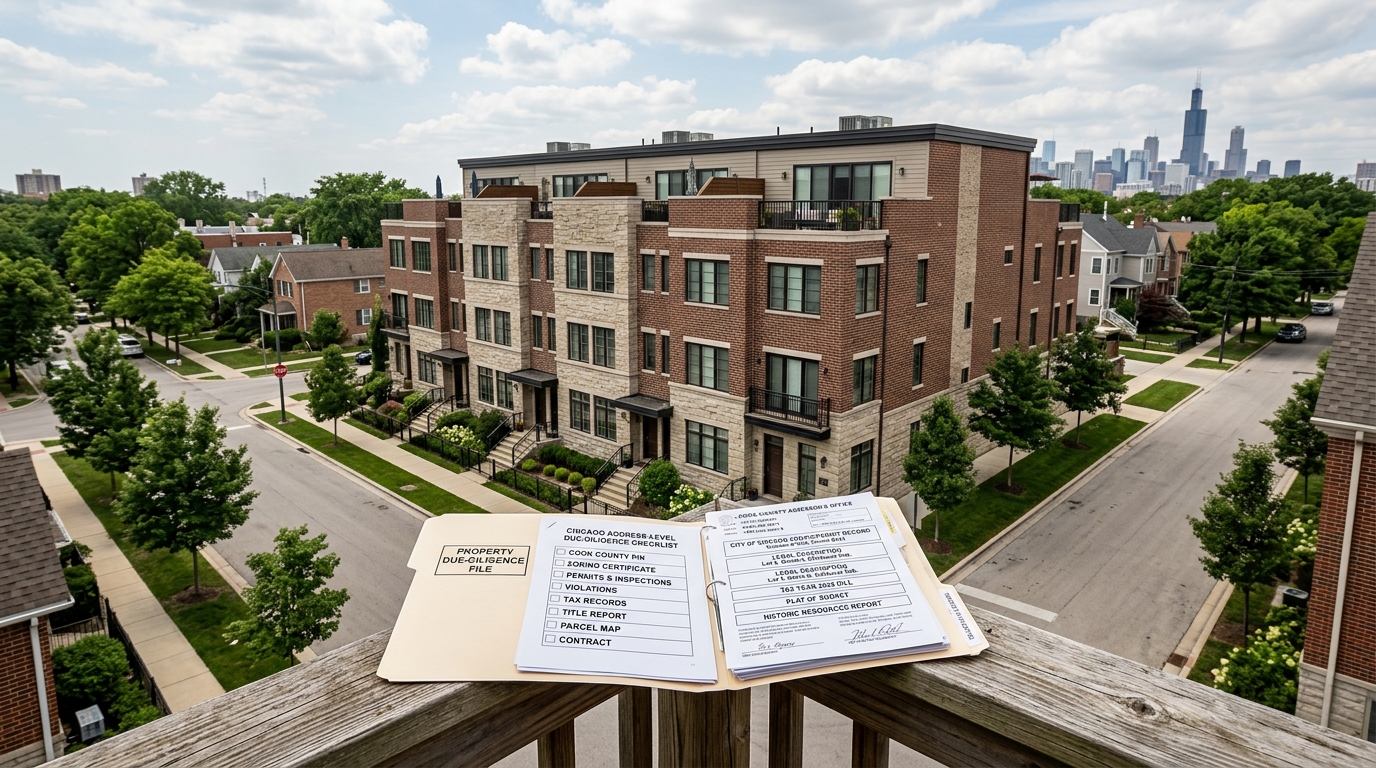
The Chicago Address-Level Due-Diligence Checklist for Buyers
Before buying a specific Chicago property, build one address-level evidence file keyed to the exact street address, unit if applicable, Cook County PIN, legal description, owner re
Before buying a specific Chicago property, build one address-level evidence file keyed to the exact street address, unit if applicable, Cook County PIN, legal description, owner record, jurisdiction, and signed purchase contract. Use that file to reconcile zoning, permits and inspections, violations, assessor and tax records, title and recorded documents, historic-resource screens, and parcel maps before the buyer's actual deadline. A Chicago street address alone may not identify the exact unit, Cook County PIN, legal description, owner record, parcel, permit record, historic record, or recorded-document chain. Match the street address, unit where applicable, Cook County PIN, legal description, owner record, jurisdiction, and official record identifiers before joining systems or drawing a parcel-level conclusion. Chicago's Zoning Map treats an address and a 10-digit PIN differently and does not establish a survey boundary, legal description, title, legal use, zoning approval, variation, permit, or development right. Reconcile the address to the correct parcel and PIN, then confirm current zoning, overlays, recorded approvals, legal use, restrictions, and proposed work with the City, a surveyor, land-use counsel, and other qualified professionals. Chicago's public permit and inspection systems carry no warranty of accuracy, timeliness, or completeness, and a located record or missing result does not prove current condition, compliance, final inspection, legal use, or complete history. Search every matched address, unit, PIN, application, permit, and record identifier; open the underlying files; verify scope, reviews, holds, payments, inspections, corrections, certificates, and final status with the responsible department; and compare records with the physical property. The permit-status site covers applications started within the last 36 months, and an address-only search exposes less information than a matched application number. Do not treat a missing or limited online result as proof that no older, differently indexed, revoked, voided, unpaid, incomplete, or unfinaled permit exists; request older and underlying records when material. A Chicago violation row is historical and informational, may not reflect current property condition, and does not establish complete compliance, outstanding enforcement, liability, title impact, or repair completion. Match every violation to its inspection and property identifiers, review status dates and underlying cases, consult the title commitment and relevant courts or administrative-hearing records, confirm agency status, and compare the record with qualified physical inspection. Cook County assessor and property-tax information does not establish title, boundaries, a survey, transaction value, appraisal, physical condition, permit completeness, zoning, legal use, or development rights. Use assessor and tax systems to reconcile identifiers and assessment context, then have the buyer's title professional, surveyor, appraiser, inspector, engineer, attorney, and other qualified professionals verify the exact property as appropriate. Recorded deeds, mortgages, releases, easements, tax liens, mechanic's liens, plats, and index links do not establish marketable title, ownership, priority, document validity, easement meaning, restrictions, boundaries, legal effect, or insurability. Have the buyer's attorney and title professional examine the complete recorded chain, plats, exceptions, liens, easements, restrictions, legal description, court or hearing matters, and proposed title coverage, with a current survey where appropriate. Historic-resource and 80-acre map data may be incomplete, dated, generalized, demolished, altered, or tied to changed addresses or PINs and do not prove current landmark status, review triggers, boundaries, title, condition, or client-specific conclusions. Verify current designation and review requirements with the City, reconcile every map result to current official records and professional field review, and do not invent any JProctor Group performance, credential, representation, transaction, or Chicago-specific local-experience claim.
Lock the address, unit, PIN, legal description, owner, and jurisdiction
Start this step with the exact identifiers named in the sealed checklist. Keep one dated evidence file, label the resolution of every record, and preserve any mismatch as an open question rather than forcing records together. This makes the chicago address-level due-diligence guide for buyers usable by the buyer, attorney, title professional, inspector, and other responsible parties without inventing a property conclusion.
Verified evidence for this step
- Verified official finding: Chicago's Zoning Map supports exact street-address or 10-digit PIN searches, but an address search centers on the street while a PIN search zooms to the parcel, making identifier reconciliation essential before parcel-level interpretation. Source: Chicago Zoning Map Help.
- Verified official finding: Cook County's Assessor guide supports address or PIN searches and describes parcel-centric profile, taxpayer, value, location, land, residential-detail, permit, division, consolidation, notice, and appeal information. Source: Assessor Property Details Navigation Guide and FAQ.
- Verified official finding: Cook County's property portal uses address or PIN discovery to connect property information and recent recorded-document, deed, and lien links, while the Clerk's schedule confirms recorded classes including deeds, mortgages and releases, easements, tax liens and releases, mechanic's liens, and subdivision plats. Source: Cook County Property Tax Portal and Recording Fee Schedule.
- Verified official finding: Chicago's Historic Resources Survey and 80 Acre Map Library can screen historic-resource, PIN, block, subdivision, lot-line, dimension, and address-delineation context, but the City's own materials warn that survey data, structures, addresses, and PINs may be incomplete or changed. Source: Chicago Historic Resources Survey and Chicago Historic Resources Survey FAQ and Chicago 80 Acre Map Library.
Verify before moving on
Record the exact match key, official system, underlying document, displayed date or status, unresolved limitation, responsible follow-up owner, and applicable contract deadline. Ask the qualified agency or professional named by the evidence to resolve material gaps. Do not convert a public-record hit, map screen, form, or index result into a property-specific legal, physical, financial, insurance, title, or transaction conclusion.
Confirm parcel-level zoning and mapped constraints
Work from the exact property identifiers, signed documents, and deadlines already established in the evidence file. Open the underlying official record, save its date and identifier, and separate what the record can show from the decision it cannot make.
Verified evidence for this step
- Verified official finding: Chicago's Zoning Map supports exact street-address or 10-digit PIN searches, but an address search centers on the street while a PIN search zooms to the parcel, making identifier reconciliation essential before parcel-level interpretation. Source: Chicago Zoning Map Help.
- Verified official finding: Chicago's Historic Resources Survey and 80 Acre Map Library can screen historic-resource, PIN, block, subdivision, lot-line, dimension, and address-delineation context, but the City's own materials warn that survey data, structures, addresses, and PINs may be incomplete or changed. Source: Chicago Historic Resources Survey and Chicago Historic Resources Survey FAQ and Chicago 80 Acre Map Library.
Verify before moving on
Record the exact match key, official system, underlying document, displayed date or status, unresolved limitation, responsible follow-up owner, and applicable contract deadline. Ask the qualified agency or professional named by the evidence to resolve material gaps. Do not convert a public-record hit, map screen, form, or index result into a property-specific legal, physical, financial, insurance, title, or transaction conclusion.
Trace permit applications, issued permits, inspections, and final status
Work from the exact property identifiers, signed documents, and deadlines already established in the evidence file. Open the underlying official record, save its date and identifier, and separate what the record can show from the decision it cannot make.
Verified evidence for this step
- Verified official finding: Chicago provides public permit and inspection records but expressly disclaims accuracy, timeliness, and completeness, so the matched record set must be traced and compared with the property rather than treated as a compliance conclusion. Source: Building Permit and Inspection Records.
- Verified official finding: Chicago's permit-status help says address-only searches provide limited information, an application number provides fuller detail, and the site covers applications started within the last 36 months while exposing review, hold, issue-date, and work-scope information. Source: Building Permit Application Status Help.
- Verified official finding: Chicago's official building-permits metadata covers issued permits from 2006 to the present, excluding permits later voided or revoked, and identifies fields such as permit number, status, milestone, type, review type, application date, issue date, address, and work description. Source: Building Permits Dataset Metadata.
Verify before moving on
Record the exact match key, official system, underlying document, displayed date or status, unresolved limitation, responsible follow-up owner, and applicable contract deadline. Ask the qualified agency or professional named by the evidence to resolve material gaps. Do not convert a public-record hit, map screen, form, or index result into a property-specific legal, physical, financial, insurance, title, or transaction conclusion.
Review violations without mistaking a status row for compliance
Work from the exact property identifiers, signed documents, and deadlines already established in the evidence file. Open the underlying official record, save its date and identifier, and separate what the record can show from the decision it cannot make.
Verified evidence for this step
- Verified official finding: Chicago's official building-violations metadata covers violations from 2006 to the present and identifies citation date, code, status, description, inspection number, and comments, while warning that the data are historical, informational, and unsuitable as a transactional enforcement conclusion. Source: Building Violations Dataset Metadata.
Verify before moving on
Record the exact match key, official system, underlying document, displayed date or status, unresolved limitation, responsible follow-up owner, and applicable contract deadline. Ask the qualified agency or professional named by the evidence to resolve material gaps. Do not convert a public-record hit, map screen, form, or index result into a property-specific legal, physical, financial, insurance, title, or transaction conclusion.
Pair assessor and tax identifiers with title, recorded documents, and survey
Work from the exact property identifiers, signed documents, and deadlines already established in the evidence file. Open the underlying official record, save its date and identifier, and separate what the record can show from the decision it cannot make.
Verified evidence for this step
- Verified official finding: Cook County's Assessor guide supports address or PIN searches and describes parcel-centric profile, taxpayer, value, location, land, residential-detail, permit, division, consolidation, notice, and appeal information. Source: Assessor Property Details Navigation Guide and FAQ.
- Verified official finding: Cook County's property portal uses address or PIN discovery to connect property information and recent recorded-document, deed, and lien links, while the Clerk's schedule confirms recorded classes including deeds, mortgages and releases, easements, tax liens and releases, mechanic's liens, and subdivision plats. Source: Cook County Property Tax Portal and Recording Fee Schedule.
Verify before moving on
Record the exact match key, official system, underlying document, displayed date or status, unresolved limitation, responsible follow-up owner, and applicable contract deadline. Ask the qualified agency or professional named by the evidence to resolve material gaps. Do not convert a public-record hit, map screen, form, or index result into a property-specific legal, physical, financial, insurance, title, or transaction conclusion.
Reconcile historic and parcel-map evidence before the buyer's deadline
Work from the exact property identifiers, signed documents, and deadlines already established in the evidence file. Open the underlying official record, save its date and identifier, and separate what the record can show from the decision it cannot make.
Verified evidence for this step
- Verified official finding: Chicago's Historic Resources Survey and 80 Acre Map Library can screen historic-resource, PIN, block, subdivision, lot-line, dimension, and address-delineation context, but the City's own materials warn that survey data, structures, addresses, and PINs may be incomplete or changed. Source: Chicago Historic Resources Survey and Chicago Historic Resources Survey FAQ and Chicago 80 Acre Map Library.
Verify before moving on
Record the exact match key, official system, underlying document, displayed date or status, unresolved limitation, responsible follow-up owner, and applicable contract deadline. Ask the qualified agency or professional named by the evidence to resolve material gaps. Do not convert a public-record hit, map screen, form, or index result into a property-specific legal, physical, financial, insurance, title, or transaction conclusion.
For separate transaction decisions, use Chicago comparable-evidence offer framework, Chicago initial asking-price guide, Chicago competing-offers review, Chicago buying-and-selling coordination guide. Those resources answer different questions and do not change this exact-address checklist, the signed contract, or its evidence limits.
Chicago address-level due-diligence record matrix
| Record check | Exact match key | Official system | What it can show | What it cannot prove | Follow-up owner |
|---|---|---|---|---|---|
| Identity and zoning | Address, unit, PIN, legal description, owner, and parcel | Chicago Zoning Map and Cook County Assessor | Matched parcel screen, zoning-map detail, and assessment context | Title, survey boundary, legal description, legal use, approval, or development rights | Buyer, City, assessor, title professional, surveyor, and attorney |
| Permit applications | Address, PIN, application number, permit number, and work scope | Chicago permit-status help and building-permits data | Reviews, holds, milestones, issue information, permit type, and work description | Older or differently indexed history, payment, completed work, passed inspections, or legal use | Department of Buildings, inspector, architect, engineer, and attorney |
| Violations and inspections | Address, PIN, violation, inspection, status date, and underlying case | Chicago building-violations data and building records | Citation, code, description, status, inspection reference, and comments | Current condition, complete compliance, liability, repair completion, or transactional enforcement status | Department of Buildings, court or hearing office, title professional, inspector, and attorney |
| Recorded title evidence | PIN, legal description, owner, deed, mortgage, lien, plat, easement, and restriction references | Cook County Property Tax Portal and Clerk recording records | Located document classes, recent links, and parcel identifiers | Marketable title, priority, easement meaning, boundaries, legal effect, or insurability | Buyer's attorney, title professional, surveyor, and lender |
| Historic and parcel maps | Current address, PIN, block, subdivision, lot, designation, and proposed work | Chicago Historic Resources Survey and 80 Acre Map Library | Historic-resource fields and reference block, subdivision, lot-line, dimension, and address context | Current designation, review trigger, survey, title, condition, or controlling boundary | City landmarks staff, surveyor, preservation professional, architect, and attorney |
Use the matrix as a routing and deadline tool. It does not supply a property-specific conclusion. Mark each row verified, unresolved, or not applicable, and preserve who is responsible for the next action. Once the exact evidence file is organized, use the contact page to request a review anchored to those records.
Official sources used in this guide
- Chicago Zoning Map Help — City of Chicago
- Building Permit and Inspection Records — City of Chicago Department of Buildings
- Building Permit Application Status Help — City of Chicago Department of Buildings
- Building Permits Dataset Metadata — City of Chicago Data Portal
- Building Violations Dataset Metadata — City of Chicago Data Portal
- Chicago Historic Resources Survey — City of Chicago
- Chicago Historic Resources Survey FAQ — City of Chicago
- Assessor Property Details Navigation Guide and FAQ — Cook County Assessor
- Cook County Property Tax Portal — Cook County
- Recording Fee Schedule — Cook County Clerk
- Chicago 80 Acre Map Library — City of Chicago
These sources establish only the claims and limitations in the sealed ledger. Their inclusion does not establish facts about a subject property or the client.
Frequently asked questions
Does a Chicago street address identify the exact property for due diligence?
Not by itself. Match the unit, Cook County PIN, legal description, owner record, jurisdiction, permit identifiers, and recorded-document references before joining results.
Does a Chicago permit search prove prior work was completed and compliant?
No. Address-only results are limited and the permit-status site has a 36-month application window. Trace matched applications and permits through reviews, holds, payments, inspections, corrections, certificates, and final status, then compare records with qualified inspection.
Can a Chicago building-violation status be used as a closing conclusion?
No. The City calls the data historical and informational and warns it may not reflect current condition. Match the inspection and underlying cases, confirm agency status, consult the title commitment and relevant court or hearing records, and inspect the property.
How should Cook County assessor and recorded-document records be used together?
Use assessor and tax resources to reconcile the exact parcel and assessment context, then have the buyer's title professional, attorney, and surveyor examine the complete recorded chain, plats, exceptions, liens, easements, legal description, boundaries, and proposed coverage.
Work With Us
Get assistance in determining current property value, crafting a competitive offer, writing and negotiating a contract, and much more. Contact us today.
Contact Us