
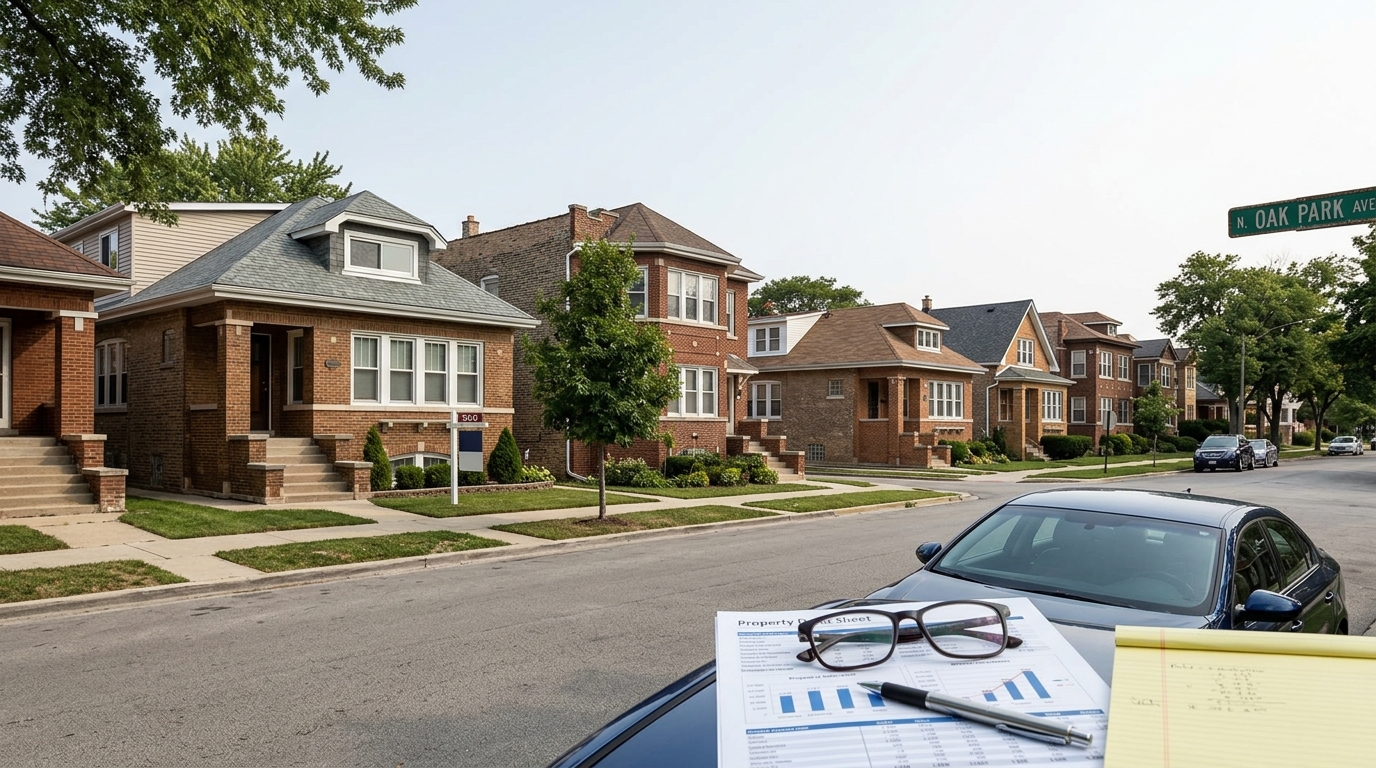
How Chicago Buyers Should Build a Comparable-Sale Offer Range
First verify the subject parcel's county because Chicago spans Cook and DuPage. For a Cook County address, screen candidate sales by location, class, age, building and land area, c
First verify the subject parcel's county because Chicago spans Cook and DuPage. For a Cook County address, screen candidate sales by location, class, age, building and land area, construction, recorded date, multi-parcel status, and the county's published sale filters. Document the data vintage, selected and rejected sales, methodology, assumptions, and limits in the written CMA. Use the result as a negotiation range and appraisal-risk input, not as a guaranteed winning price or an appraisal.
A DuPage County parcel-sales workflow equivalent to the Cook County fields in this pack.
Chicago has a small DuPage portion, but this topic retrieval did not open a DuPage transaction dataset with equivalent fields.
Any target address, owner, buyer, seller, or named private comparable set.
The pack establishes method and public fields only; person-level and client-private facts are outside scope.
A customary adjustment, standard overbid percentage, guaranteed winning price, or guaranteed appraisal result.
No opened source establishes these private negotiation outcomes.
Verify whether the subject is in Cook or DuPage County
Chicago is not entirely within one county. The 2020 Census Illinois place reference file identifies Chicago city as spanning Cook and DuPage counties. That makes county verification the first step, not an optional detail.
The public-record workflow in this guide is Cook County-specific. If the subject parcel is in DuPage County, replace every Cook-specific record step with verified DuPage sources before using it. Do not assume that a Chicago mailing address establishes the county or that the two counties publish equivalent fields.
County identity matters because the record source, field definitions, filters and timing warnings come from the publishing county. A defensible worksheet should name the county and record source at the top so later readers can tell which rules were applied.
Chicago buyers who are still comparing locations can separately review how market context changes from Chicago to Glen Ellyn. That broader guide is not a substitute for parcel-level county verification.
Define the subject before searching for sales
Comparable screening starts with observable subject criteria. The Cook County Assessor identifies location, class, age, building square footage, land square footage and construction characteristics as comparability factors. It also warns that matching property class alone is insufficient.
Write the subject criteria before opening a candidate-sale list. This creates a stable standard for accepting, rejecting or flagging each record. It also prevents the search from drifting toward whichever sales happen to support a preferred number.
The worksheet can include fields for:
- county and parcel identifier;
- location and market-area notes;
- property class;
- age and construction characteristics;
- building and land square footage;
- recorded sale date and data vintage;
- multi-parcel and county sale-filter flags; and
- the reason each candidate was selected, rejected or retained with a caution.
Assessor comparability is a screening framework, not a buyer appraisal or offer-price opinion. Assessed value should not be called market value or used as an offer price.
For a separate discussion of buyer priorities in a specific suburb, see the Western Springs homebuyer market guide.
Use Cook County's parcel-sale screening fields
Cook County's Parcel Sales dataset metadata publishes parcel or PIN sale fields including sale price, recorded sale date, document number, neighborhood code, property class and multi-sale or filter indicators.
Those fields support a transparent first-pass screen. They do not prove that a transfer was arm's-length, that its condition matched the subject, or that the sale belongs in a final comparable set.
| Field | Source | Match rule | Reject or flag |
|---|---|---|---|
| County and PIN | Census place file and county parcel record | Confirm the subject is in Cook County before this workflow | DuPage parcel or unresolved county |
| Location and neighborhood code | Cook County parcel-sale metadata | Record the published location field and evaluate market relevance | Different market context without support |
| Class, age and construction | Cook County Assessor guidance | Compare multiple physical characteristics, not class alone | Material mismatch without explanation |
| Building and land area | Cook County Assessor guidance | Record both measures and identify meaningful differences | Missing or materially different size |
| Recorded sale date | Cook County parcel-sale metadata | Label it as recorded date and state the data vintage | Treated as contract date or assumed current |
| Multi-parcel and sale filters | Cook County parcel-sale metadata | Review the county's indicators for each candidate | Unresolved multi-sale, repeat-price, low-price or deed-type flag |
Any target address, owner, buyer, seller, or named private comparable set. The pack establishes method and public fields only; person-level and client-private facts are outside scope.
Match physical and location characteristics
The Cook County Assessor's comparable-properties guidance names several characteristics to compare and gives an example showing why matching class alone does not establish comparability. That supports a multi-factor review rather than a one-field filter.
A buyer's worksheet should show where a candidate differs from the subject. The evidence supports recording observable differences. It does not provide customary dollar adjustments or a formula for converting each difference into an offer.
Location should be treated as more than a shared city name. Age, building area, land area and construction characteristics can also change whether a sale is useful. A candidate with an unresolved material difference can remain flagged rather than being forced into the range.
Buyers weighing housing forms and settings may also use the Chicago-versus-Elmhurst buyer guide as general context, while keeping the actual comparable screen tied to the subject's county and characteristics.
Carry lag and record-date limits into the analysis
Cook County defines sale_date as a recorded date. Its metadata includes a separate is_mydec_date flag for a more precise Illinois Department of Revenue date and warns that records may populate months after recording.
Every recency statement should therefore carry two facts: what the date field means and when the dataset was retrieved. A recent search result is not proof that every recent transaction has already appeared.
The county also exposes multi-parcel indicators and filters for same-price repeat sales, sales below $10,000 and specified deed-type problems. Those filters are screening aids. They do not prove an arm's-length transaction and should not replace review of the record and property characteristics.
Document the CMA method and its limits
Illinois law establishes specific disclosure requirements for a written comparative market analysis or broker price opinion. 225 ILCS 454/10-45 requires the written document to state its intended purpose, subject interest, methodology, assumptions and limiting conditions, broker interest, preparer identity, license and signature, and that it is not an appraisal.
| Required element | What to record | Evidence |
|---|---|---|
| Intended purpose | Why the CMA or BPO was prepared | Illinois statutory disclosure requirement |
| Subject interest | The real-property interest being analyzed | Illinois statutory disclosure requirement |
| Methodology | Sources, screening rules, data vintage and selected or rejected sales | Illinois statute and source-bounded worksheet method |
| Assumptions and limits | County boundary, recorded-date meaning, lag and unresolved differences | County sources and Illinois statute |
| Broker interest | Any required interest disclosure | Illinois statutory disclosure requirement |
| Preparer identity | Name, license and signature | Illinois statutory disclosure requirement |
| Not-an-appraisal statement | State clearly that the written CMA or BPO is not an appraisal | Illinois statutory disclosure requirement |
A customary adjustment, standard overbid percentage, guaranteed winning price, or guaranteed appraisal result. No opened source establishes these private negotiation outcomes.
The appropriate output is a documented range with its assumptions visible. It is not a certainty claim. A buyer can use that range as a negotiation and appraisal-risk input without promising that a price will win or appraise.
For seller-side context on how pricing is framed, the Chicago asking-price guide is a separate resource and does not alter the buyer-side evidence boundaries here.
Questions about Chicago comparable evidence
Is all of Chicago in Cook County?
No. The 2020 Census place file identifies Chicago city as spanning Cook and DuPage counties. Verify the parcel's county before applying county-specific record steps.
Does a Cook County sale date equal the contract date?
Not necessarily. The county defines the field as a recorded date, provides a separate flag for a more precise Illinois Department of Revenue date, and warns of publication lag.
Are two homes with the same class automatically comparable?
No. Cook County's guidance also identifies location, age, building square footage, land square footage and construction characteristics, and warns that class alone is insufficient.
Is a CMA an appraisal?
No. Illinois requires a written CMA or BPO to state that it is not an appraisal. It must also disclose its purpose, methodology, assumptions and limits and the other statutory elements.
To apply this documented process to an actual Chicago property without inventing private facts, contact the JProctor Group.
Work With Us
Get assistance in determining current property value, crafting a competitive offer, writing and negotiating a contract, and much more. Contact us today.
Contact Us